




Accrediting Agency of Chartered Colleges and Universities in the Philippines (AACCUP), Inc.
Level III Phase 2 · Online Survey Visit · September 7–11, 2026
Bachelor of Industrial Technology
Major in Electrical Technology
College of Technology · Bohol Island State University – Calape Campus
Welcome to the official digital portfolio for the Level III Phase 2 AACCUP Accreditation of the Bachelor of Industrial Technology Major in Electrical Technology (BIndTech–ELT) program at Bohol Island State University – Calape Campus. Prepared for the evaluation on September 7–11, 2026, this site serves as a central repository of compliance documents, performance reports, and empirical evidence. It highlights our steadfast commitment to academic rigor, institutional growth, and industry-aligned technical education. We warmly invite our accreditors, partners, and stakeholders to explore the pages and discover our ongoing pursuit of excellence.
The program is the bus; each area under accreditation is a feeder off it. Gold breakers are the mandatory areas, violet the declared ones. Select any breaker to open that area, or use the Accreditation Documents page.
Four areas under evaluation
Level III accreditation is conducted in two phases. Phase 1 established the program's readiness against the mandatory requirements and two chosen areas. Phase 2 is undertaken to comply with the recommendations arising from the Phase 1 visit, and covers the four areas in which excellence is claimed: instruction and extension, which are mandatory, together with faculty development and linkages.
Instruction
Curriculum and program of studies, instructional processes, assessment of academic performance, and management of learning.
Extension
Priorities and relevance, planning and implementation, and the monitoring and evaluation of community involvement.
Faculty development
Academic qualifications, faculty and development, professional performance and scholarly works.
Linkages
Institutional linkages supporting instruction, practicum placement, and competency assessment.
For the accrediting team
The Accreditation Documents page is organized exactly as the survey instrument is organized. Each area opens to its parameters, its compliance report, its program performance profile, and its self-survey rating.
Open the accreditation documents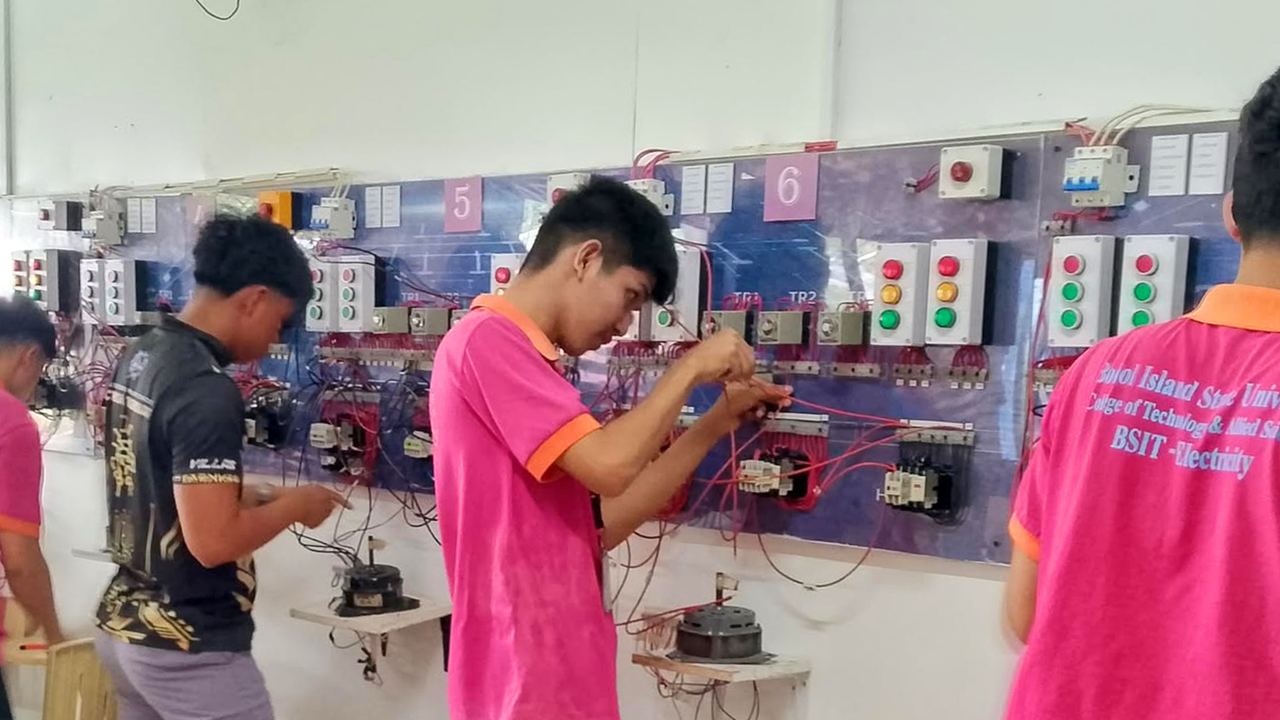
Students wiring and testing motor control circuits at the laboratory panel boards in the Industrial Technology Laboratory Room.
BISU and the Campus
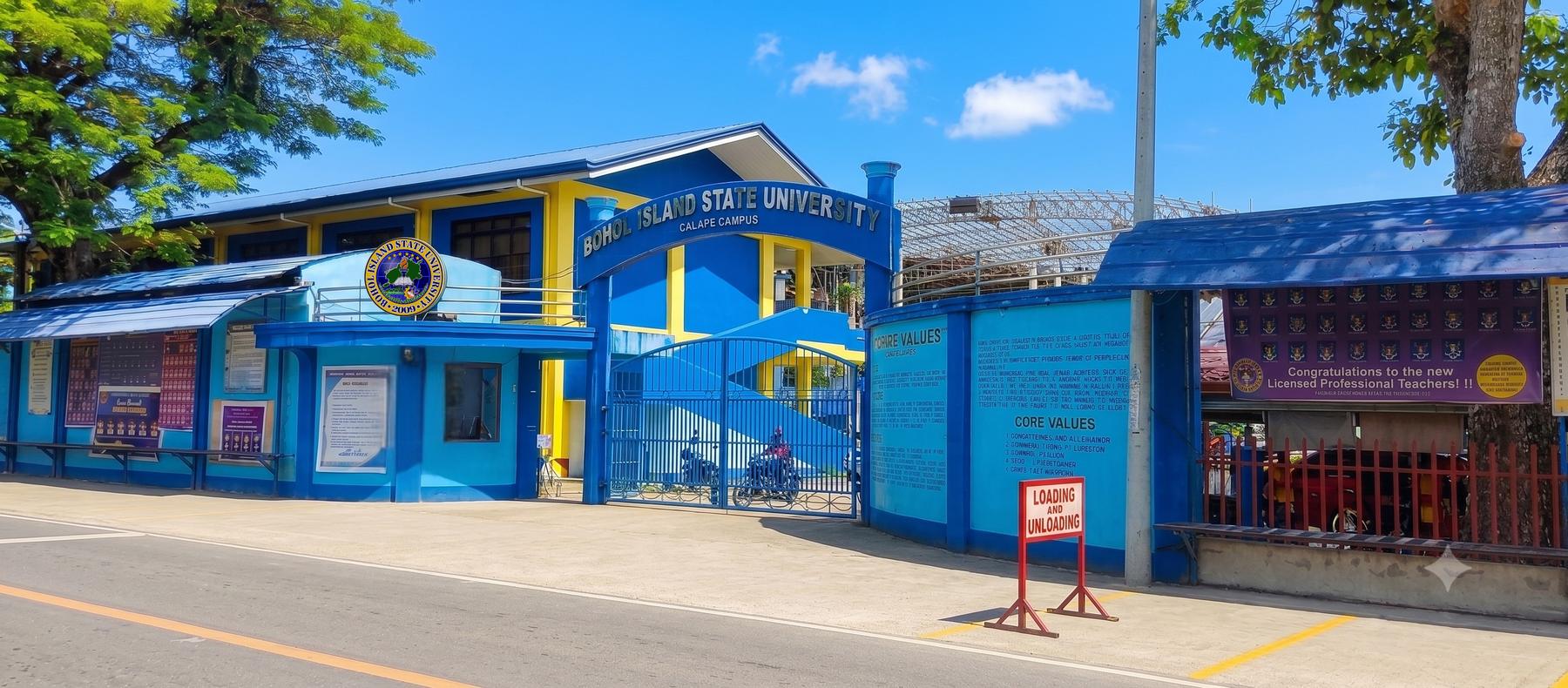
The Bohol Island State University (BISU) Calape Campus is dedicated to academic excellence, quality service, and holistic student development. In its pursuit of becoming a premier Science and Technology University, BISU delivers quality instruction, responsive research, sustainable extension programs, and viable production projects, ensuring graduates who are globally competitive, work-ready, and values-driven.
Vision
A premier Science and Technology university for the formation of a world class and virtuous human resource for sustainable development in Bohol and the country.
Mission
BISU is committed to provide quality higher education in the arts and sciences, as well as in the professional and technological fields; undertake research and development, and extension services for sustainable development of Bohol and the country.
Goals
To deliver its mandate, BISU shall- Pursue faculty and education excellence and strengthen the current viable curricular programs, and develop curricular programs that are responsive to the demands of the times both in the industry and the environment;
- Promote quality research outputs that respond to the needs of the local and national communities;
- Develop communities through responsive extension programs;
- Adopt efficient and profitable income generating projects and enterprises for self-sustainability;
- Provide adequate, state-of-the-art and accessible infrastructure support facilities for quality education;
- Promote efficient and effective good governance supportive of high quality education.
Quality Policy
To achieve these, we commit to- Deliver quality higher and advanced education, professional and technological instruction, by developing and strengthening curricular programs which are responsive to the academic community and demands of the times;
- Conduct value-adding researches that are relevant to the institution and collaborators, and implement adaptive extension programs that are responsive to the needs of the communities;
- Engage in profitable enterprises for sustainability of the institution and communities;
- Provide state-of-the-art and accessible infrastructure support facilities for the institution's clientele satisfaction;
- Offer engaging and meaningful support services for student development; and
- Implement efficient and effective administration of the different programs of the institution while continually improving our Quality Management System.
Balance, Integrity, Stewardship, Uprightness
The core values of Bohol Island State University are represented by the acronym BISU. These core values serve as guiding principles that shape the culture, behavior, and decision-making processes within the university community.
History
The Bohol Island State University (BISU) was established on October 14, 2009 through Republic Act 9722, converting the Central Visayas State College of Agriculture, Forestry, and Technology (CVSCAFT) into a state university. This transformation consolidated campuses in Tagbilaran City and the municipalities of Bilar, Candijay, Clarin, Calape, and Balilihan. The law, signed by President Gloria Macapagal-Arroyo, was made possible through House Bill No. 5638, authored by Representatives Edgar M. Chatto, Roberto C. Cajes, and Adam Relson L. Jala. Dr. Elpidio T. Magante became the first university president, steering BISU's growth as a higher education institution in Bohol.
Before its elevation to university status, BISU had long been a product of integration and expansion. Under Republic Act 8659 (1998), CVSCAFT brought together five independent schools: the Bohol Agricultural College, Bohol School of Fisheries, Clarin School of Fisheries, Calape National School of Fisheries, and the Bohol School of Arts and Trades. Over time, additional campuses were integrated, including Calape Polytechnic College and later the Balilihan Campus, which officially became BISU's youngest campus under RA 9722. By Academic Year 2009–2010, the institution already served nearly 10,000 students with over 350 faculty and staff.
From its beginnings as scattered vocational and technical schools, BISU has evolved into a leading institution of higher learning in Central Visayas. It has built strong partnerships with government agencies, local government units, and international institutions, advancing research, extension, training, and production initiatives. BISU takes pride in its alumni who have become industry leaders, innovators, and top achievers, embodying the values of excellence, service, and integrity. Today, BISU continues to cultivate a culture of quality education and innovation as it pursues its vision of becoming a premier Science and Technology University.
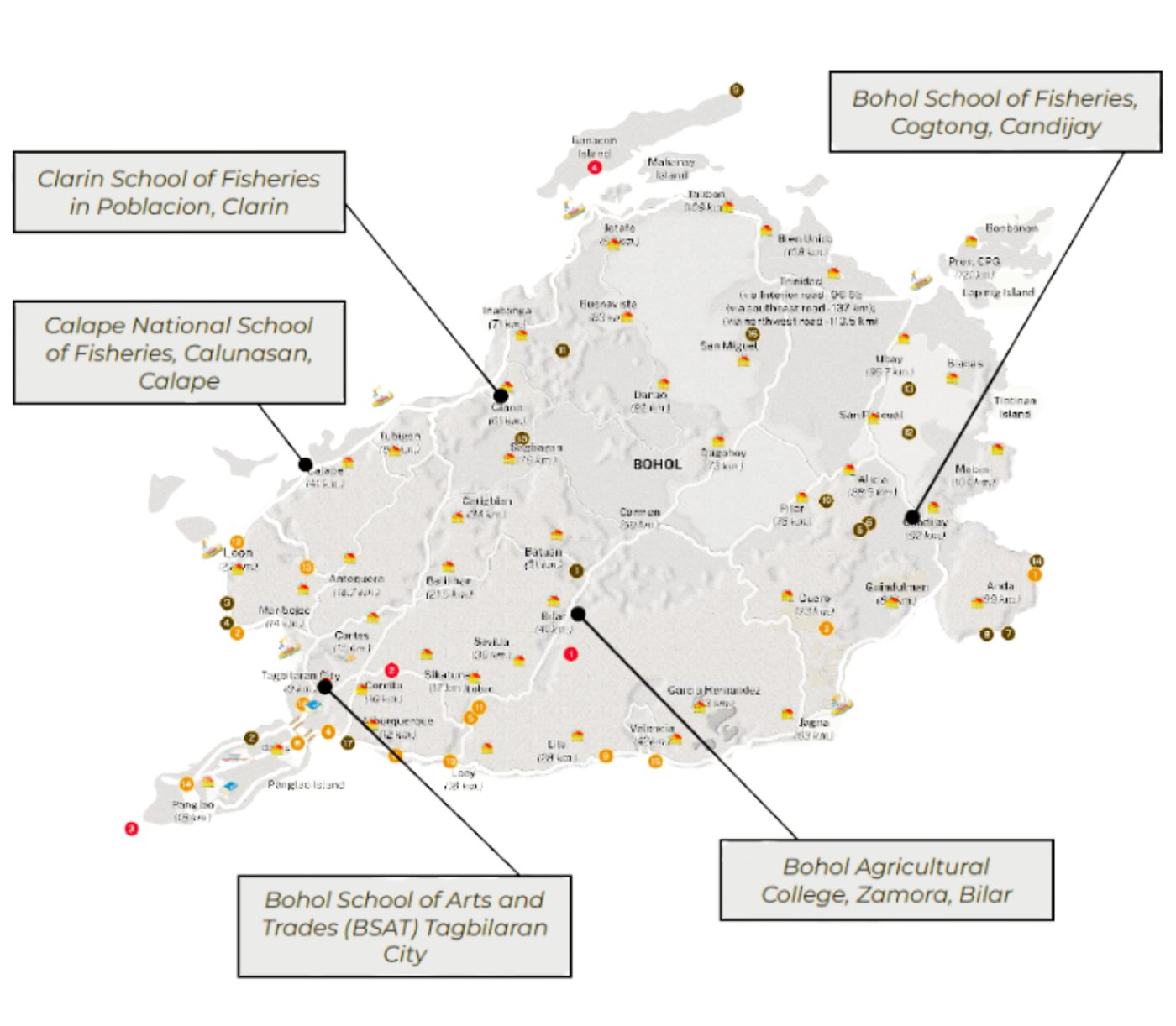
The founding institutions integrated into Bohol Island State University: Bohol School of Arts and Trades in Tagbilaran City, Bohol Agricultural College in Zamora, Bilar, Bohol School of Fisheries in Cogtong, Candijay, Clarin School of Fisheries in Poblacion, Clarin, and Calape National School of Fisheries in Calunasan, Calape.
Program offerings
College of Teacher Education
- Bachelor of Elementary Education
- Bachelor of Secondary Education — Major in English
- Bachelor of Secondary Education — Major in Mathematics
College of Technology
- Bachelor of Industrial Technology — Major in Electrical Technology
- Bachelor of Industrial Technology — Major in Food Preparation Services Technology
- Bachelor of Science in Computer Science
College of Fisheries
- Bachelor of Science in Fisheries
College of Midwifery
- Bachelor of Science in Midwifery
Location
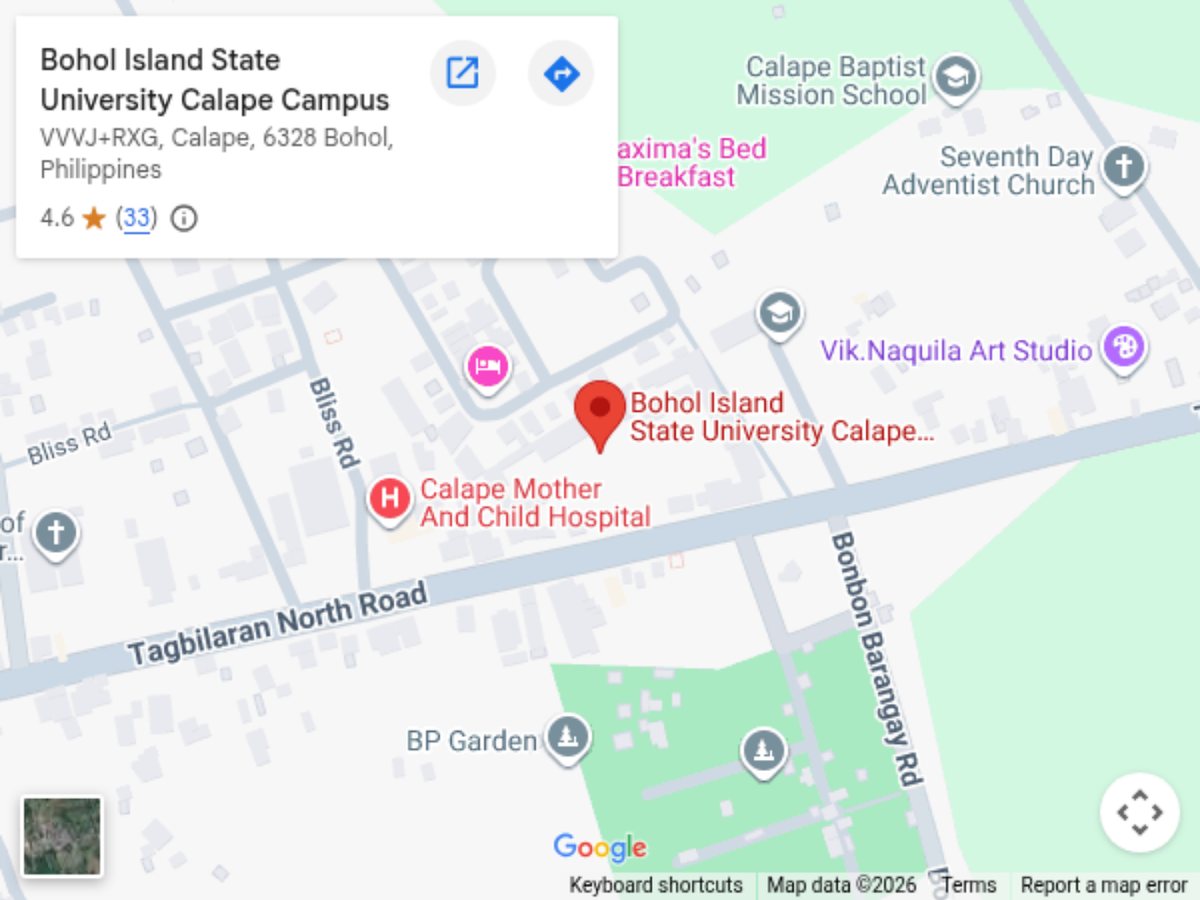 Open in Google Maps →
- Address
- San Isidro, Calape, 6328, Bohol, Philippines
- Telephone
- +63 (038) 507 9583
- info.calape@bisu.edu.ph
Campus Key Officials
The campus administration, colleges, and service offices supporting the program.
The BIndTech ELT Program
Bachelor of Industrial Technology, Major in Electrical Technology
Program overview
Bohol Island State University – Calape Campus, College of Technology, offers the Bachelor of Industrial Technology (BIndTech), Major in Electrical Technology. The undergraduate program is designed to produce graduates who possess the knowledge, skills, values, and competencies required by industry and aligned with national and international standards. It promotes outcomes-based education, quality assurance, and industry relevance in Industrial Technology programs.
Under CHED Memorandum Order No. 13, Series of 2023, there is a need for a well-educated and skilled workforce in the field of industrial technology, which is considered an important factor in the advancement of the country. Higher education institutions offering Industrial Technology programs are mandated to perform the crucial role of providing education and training for production and manufacturing manpower skills, with graduates capable of performing technical, managerial, research, and entrepreneurial roles and functions.
Article IV, Section 5.2 of the same Order provides that the BIndTech program is intended to prepare students for a professional career in Industrial Technology. The program shall impart a body of knowledge, skills, attitudes, values, and experiences that will provide prospective industrial workers with the competencies essential for effective and efficient production and manufacturing technologists and research functions.
The Curriculum Description under Article V, Section 10 further emphasizes that the Bachelor of Industrial Technology curriculum is designed for the preparation of students for a higher industrial workforce equipped with technical, managerial, research, and entrepreneurial competencies in the different fields of industrial technology. Specifically, it is expected to produce manufacturing and production technologists who can work individually or team up with scientists or engineers for the advancement of industrial technology, research, training, and production, and who can assume the following major roles:
- Improve productivity, make people employable, enhance human capital, attract investment, and ignite a virtuous cycle of development;
- Efficiently produce goods and services that meet the requirements of domestic and international markets;
- Develop innovative technologies significant to sustainable national development;
- Model technologists imbued with proper work attitudes and values as practiced in the industry; and
- Develop nationally certified technologists in their field of specialization.
BIndTech Program Outcomes
The program outcomes for BIndTech are given in the following minimum set. Graduates of the program must have:
- Ability to analyze broadly-defined industrial technology processes by using analytical tools that enhance creativity, innovativeness, and intellectual curiosity to improve methods, processes, and systems that meet the industry standards;
- Ability to implement broadly-defined industrial systems, components, products, or processes to meet specific industry needs with proficiency and flexibility in the area of specialization in accordance with global standards;
- Ability to apply appropriate techniques, resources, and state-of-the-art industrial technology tools to meet current industry needs, and use these modern tools and processes to improve and increase entrepreneurial activities upholding the safety and health standards of business and industry;
- Ability to communicate with diverse groups of clienteles the appropriate cultural language with clarity and persuasion, in both oral and written forms, including understanding and giving of clear instructions, high comprehension level, effectiveness in delivering presentations and writing documents, and articulating technological innovation outputs;
- Ability to develop leadership and management skills in a team-based environment by making informed decisions, keeping the team motivated, acting and delegating responsibility, and inspiring positive changes in the organization by exercising responsibility with integrity and accountability in the practice of one's profession;
- Practice the moral responsibilities of an industrial technologist to manage and balance wider public interest and uphold the norms and safety standards of the industrial technology profession;
- Ability to demonstrate enthusiasm and passion for continuous personal and professional development in broadly-defined industrial technology and effecting positive changes in the entrepreneurial and industrial endeavor; and
- Recognition of the need for, and an ability to engage in, lifelong learning.
Program Curriculum
Revised Curriculum, Academic Year 2024–2025. Approved under BOR Resolution No. 04-19-044A, s. 2024, and noted by CHEDRO VII.
Summary of Units
Certified by Benjamin N. Omamalin, PhD, University Director of Instruction. Recommended for approval by Maria Lilibeth G. Castil, PhD, VP–Academic and Quality Assurance. Approved by Anthony M. Penaso, PhD, University President. Noted by CHEDRO VII.
Career opportunities and employability
Graduates of the program are positioned for technical, supervisory, and entrepreneurial roles in the electrical trades and allied industries:
Installation and maintenance
- Building and industrial electrician
- Electrical maintenance technician and supervisor
- Electric cooperative lineman or technician
- Facilities and utilities maintenance personnel
Industrial controls and automation
- Motor control and panel building technician
- Instrumentation and process control technician
- PLC and automation support technician
- Plant maintenance and reliability personnel
Technical services and compliance
- Electrical estimator and plan reader
- Electrical inspector and safety officer
- Quality assurance personnel for electrical works
- Accredited trainer or competency assessor
Entrepreneurship and further study
- Electrical contracting and services enterprise
- Retail and supply of electrical materials
- Graduate study in technology or engineering education
- Pathway to higher national certification
Program Organizational Chart
College of Technology · Bachelor of Industrial Technology, Major in Electrical Technology.
AACCUP Online Survey Visit7–11 September 2026
Accreditation documents
Organized as the survey instrument is organized. Each area opens to its parameters, its compliance report, its program performance profile, and its self-survey rating.
Documentary support
Areas Under Evaluation
Each area opens to its parameters, its program performance profile, and its self-survey rating.
Compliance Report
Phase 2 is undertaken to comply with the recommendations arising from the Phase 1 visit. Each recommendation is set out below with the action taken and the supporting evidence.
The Accrediting Team
The AACCUP accreditors assigned to this survey visit.
The Local Taskforce
The campus taskforce for the Level III Phase 2 survey visit, organized by the areas under evaluation, the compliance report areas, and the support team. Focal persons are marked.